

Penraevon: A Name That Refused to Stay Put
There is a moment, when you research an old house, where history stops behaving itself. You begin with sensible intentions, deeds, census records, and architectural plans, and instead find yourself following a name that keeps turning up in the wrong places. Not metaphorically wrong. Geographically wrong. Emotionally strange. It is easy to find the facts but to make sense of them and uncover the story they tell is not so simple.
Penraevon was like that.
It appeared often, always accurately, and never with an explanation. Streets, houses, estates, yachts. All real. All connected. None of it is obvious. It felt less like research and more like being led somewhere by something that knew where it was going.
I have learned not to resist that feeling.
The Man Who Named the House
Penraevon was built in the early 1880s by a man named John Franks. He gave the house its peculiar name and never lived in it.
John Franks was not a man given to whimsy. He was practical, ambitious, and methodical. Born locally, working from the age of nine, he climbed steadily from stable boy to plasterer, entrepreneur, surveyor and businessman
And yet this name.
Not only did he give it to our house, he also reused it.
We tried to find out what Penraevon meant. Linguistically. Historically. Emotionally. It yielded nothing.
Which suggests it meant something very to John Franks and, more importantly his adopted daughter.
The Child Who Wasn’t Quite His
John Franks and his wife Annie had no children. But they did have a daughter.
Helen Bairstow appears in the records as “Adopted Daughter”. She was not an orphan. Her mother was John Franks’ cousin. Her father a leatherworker. A family with nine children living in poverty but one whose trajectory bent upwards when Helen was taken in by the Franks.
Helen was raised into comfort, education, and possibility. And when John Franks died (years after an embarrassing newspaper obituary mistakenly declared him dead).. Helen at the age of 19, inherited a large fortune and momentum.
A Man Who Lived at Full Speed
Aged 20, a year after her adoptive father’s death, Helen married. Her husband, Sydney Smurthwaite, was flamboyant, theatrical, energetic, socially expansive and looked to be great fun.
He ran football clubs. Ice rinks (devised football on ice), theatres, cinemas. He fundraised publicly. He posed for photographs beside famous actresses. He was, in short, a man who liked the world to notice him.
And wherever this young couple went, something curious happened.
They lived at Penraevon.
Hull. Newcastle. Durham. London (two locations). Whitstable.
Different houses. Same name.
The House That Travelled
This is the part where the story stops being about buildings and starts being about belonging.
Each Penraevon marked a turning point. A relocation. A reinvention. Early cinema. Wartime propaganda. Film distribution, retirement. Penraevon was recreated again and again not as architecture, but as an idea. A constant carried through change.
Helen died in her 50s, Sydney lived on. And still, he lived at Penraevon.
What the Name Meant
By the end, there had been Penraevons across England including a yacht. Only two houses survive now: the first and the last.
Helen lived in neither.
And yet Penraevon followed her everywhere.
It seems that Penraevon was never just a house. It was an idea of home – portable, persistent, recreated wherever life took them.
Which makes standing in this Penraevon now feel rather extraordinary
The full story is explored below
The Full Story – all the facts
Let’s be Frank
John Franks was a local lad from Chapel Allerton, he was born to Samuel And Hannah Franks and he had a twin sister Harriet both born on Jan 2nd 1836, a brother Thomas and a younger sister Emmeline. They were both christened in St Matthews Church which is less than a mile from the house on January 6th 1836. His father was a groom and John went to work at the age of 9 as a stable boy, His father dies when John is 11, life seems to have been very hard for the Franks for the next few years. Later he marries Annie, she is from Harewood. Over their lifetime they manage to change their fortunes from poor to very rich.
By 1871 John Franks is 35, a Plasterer living on Regent Street, Chapel Allerton Leeds employing 21 men and 2 boys. He is named as being responsible for the plasterwork at the Grand Theatre in Leeds and is working with the architect Corson (In 1873 he becomes a freemason which I am sure helped his prospects). John’s twin sister dies in 1874 aged 38.

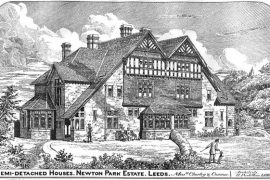
In 1881 aged 45, he lives at Newton Cottage, on Potternewton Lane, Chapel Allerton and is a Builder (working with his brother in law to form Franks and Evans) employing 80 men and 3 boys (tripling his workforce over ten years), Annie is now 48, they have no children. Our house, Penraevon is built by John Franks in 1881 (finished in 1882, and we do have some fancy plasterwork). The 1881 Electroral Roll (which lists those eligible to vote i.e men over 30 who owned property) details John Franks as owning Penraevon. He lives at The Rookery in Chapel Allerton. In 1888 he buys, in conjunction with his business partner William Warren, 6 acres of the Royal Park Estate and designs the street layout he then sells blocks to various speculative developers to build terrace housing.
By 1891 aged 55 he is a surveyor and valuer. He was the first surveyor for Leeds Permanent Building Society . The Franks are now living in Grove House on Harrogate Road, Chapel Allerton with their Adopted daughter Nellie Bairstow aged 9 from Roundhay.
Bootmaker Bairstow
Obviously the adopted daughter came as a surprise to us. Who was Nellie Bairstow? Helen (Nellie) Bairstow was one of nine children, she is born in Roundhay (very close to Chapel Allerton), Leeds in 1881 , she is not an orphan. We know that she was adopted by the Franks sometime between birth and nine years old. Her mother, Ada Mary Bairstow was John Frank’s cousin.
In 1881 Thomas and Ada Mary Bairstow and her three siblings lodge at their uncles house with his family. Later that year Helen is born. Thomas Bairstow (her father) works as a leather clicker, by 1891 he is a Bootmaker no longer lodging with the uncle. Their fortunes are definitely changing, by 1901 he is living in Ladywood Road Oakwood with 6 of his children, the eldest works in the boot shop with him and the younger ones have a visiting tutor.
In 1911 Thomas, Ada and five of their children all live above their shoe shop on Oakwood Parade (462 Roundhay Road) in Leeds. In 1915, their youngest daughter Dorothy gets a scholarship to Leeds Girls’ High School. Thomas Bairstow dies in 1925 but his wife Ada Mary continues to run the shop with his children (now adults). This photo was taken in the 1930’s.
As for Helen, the Franks never change her name and she is always referred to in official records as ‘Adopted Daughter Helen Bairstow’.
The death of Franks
In Nov 1900 The Yorkshire Post announce the Death of Mr John Franks, they are surprised as although they knew he had been ill…they did not think he had been that ill.

Two days later they publish an apology as John Franks is not dead, but the dairy farmer John Franks is. It appears there is another John Franks who dies after a long illness who lives nearby at Scott Hall Farm and The Yorkshire Post had muddled the two men up. This comes as no surprise to me as I kept coming across the other John Franks. He was christened at the same church, lived nearby but was a farmhand then dairy farmer he also married a woman named Anne but they had a son who later died as a young man in a farming accident.
The Yorkshire Post seem deeply relieved that they got the wrong John Franks , there is no obituary for the actual John Franks who did die.

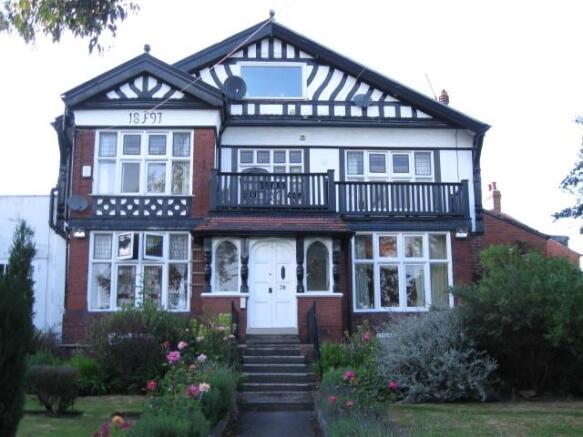
In 1901 the Franks are still alive and listed as living at 78 Potternewton Lane, Leeds – which they name ‘Broomhill’. This house still exists and is a few streets away from our house. They are recorded as living there in 1898 and presume it was built by John Franks in 1897. In the census John Franks is described as as retired surveyor aged 65 living with his wife, Helen Bairstow-adopted daughter aged 19, and a general servant Sarah aged 23
The second death of Franks
Unfortunately, by May 1901 John Franks does die and is buried on the 11th May, aged 65 years. His widow and adopted daughter follow the coffin. And he gets another Obituary.

John Franks’ estate is valued at over £22,000 (roughly £3 million in today’s money). It is divided as follows according to the Yorkshire Post (who get his name wrong). His wife Annie dies later that year, their adopted daughter Helen is just 19 years old. Helen inherits £30 plus an income of 3/5 of his estate which is to be invested by his trustees 2/5 to his sister Emmeline Evans. Ada Mary Bairstow (Helen’s mother) is given £100 which seems likely the reason they were able to buy the boot makers shop, which was newly built on Oakwood parade.

Meet the Smurthwaites
Helen marries Sydney Thornton Smurthwaite the next year 1902, aged 20. How she met him and whether the Franks ever met him we don’t know. The marriage certificate says she is living in Roundhay, so maybe she moved in with her parents. Thomas Bairstow (her father) gives her away. We have no idea if John Franks would have given her away if he was alive.


Sydney Smurthwaite’s parents ran a large Haberdashery in Hull.
The first we hear of the newlywed Smurthwaites is in 1904. They are living in Hull. Sydney or Cyd to his friends, is a busy man. He is a councillor, Chairman of Hull City Football Club, Manager of Cleethorpes Skating rink (where he introduced Football on Ice) and Proprietor of his fathers shop which he renames Cyd Smurthwaite. He appears to be quite a showman, joker and very popular.


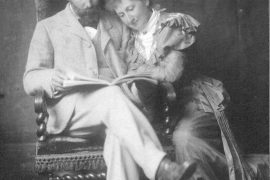
In January 1906, The Hull tug Star sank in the Humber, leaving two men, James Atkinson and Walter Brammer Ferndale dead and two families fatherless. In response, local politician, fancy-goods retailer, former Hull City director (and prominent supporter) Sydney Smurthwaite uses his energy and contacts to organise a fundraising football match at the Boulevard for the families of the deceased. The photo shows Sydney sitting cross-legged at the front of a publicity photo for the event alongside Marie Studholme . Marie was described in a local paper as ‘the famous musical comedy actress, the most photographed woman in the world and generally considered the loveliest woman on the English stage’

But all of this is just background for what is the real story…
The legacy of Penraevon
This is where it gets interesting. Where do they live? They live in Penraevon, Cottingham, Hull. This seems to set a trend for the rest of their married life as you will see.
In 1909, Sydney’s father dies. This seems to give them the freedom to sell the shop. They move to Newcastle. He is manager of Pavilion Theatre of Varieties and they live in (…wait for it) Penraevon, Lovaine Terrace, Newcastle upon Tyne. The Pavilion had a bioscope which was used to show early films and films become Sydney’s passion.

In 1914 they move to Durham, he becomes Managing Director of the Empire Theatre, they live at (go on, guess) Penraevon, Egerton Road Durham.

During the first world War they move to London where Sydney works with Lord Beaverbrook. He is made “Director of the Tour of England of the Great National Kinematograph Review of His Masters Naval and Military Forces”. Which put plainly means he was responsible for organising the tour of theatres with the earliest British propoganda film “Britain Prepared”.

Sydney did not have good health, rheumatic fever in 1904 which returned in 1913 left him very unwell, he even travelled to Egypt for 16 weeks to recuperate.
His Medical dismissal papers lists his address as (you know already…) Penraevon, Laurel Bank, Hoop Lane, Golders Green. He also lists his business as General Manager Fabion (?), Booking offices ltd, Director Moss Empire, Managing Director Chambers and Smurthwaite, Chairman and Managing Director North British Electric Theatres. We also know he was a founding member of the Anima Lodge, a branch of the freemasons for the film industry.

In 1924 he opens offices in Soho, London as a film distributor. Guess what? they live at Penraevon, Golders Green Crescent. By now Chambers and Smurthwaite are proprietors of a large number of cinemas across the country.
Retire to the coast
In the late 1920’s they retire to Chestfield in Whitstable where they seem to have a full social life involving setting up the scouts, playing golf and renovating old houses. In 1932 Helen dies aged 50, they are living in Shepherds Cottage (disappointing). But, in 1939 Sydney is recorded as living at Penraevon, Chestfield nr. whitstable as a retired theatre cinema proprietor still with the same servant they had from 1909.
In 1941 Sydney dies and leaves his estate to Helen’s younger sister Hilda Bairstow. Hilda 54, is unmarried and still living with her mum Ada above the shop in leeds. Ada May Bairstow dies aged 90 in 1943 and Hilda dies in 1961 aged 74.


Penraevon always seems to have meant home for Helen and Sydney. At one point there was a Penraevon in Hull, Newcastle, Durham, two in London, two in Leeds (plus a handful of streets), one in Boston Spa and the final one in Whitstable. Only the first and last Penraevon survive to this day, both houses where Helen never lived.
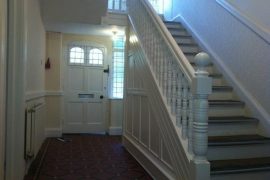
Below is a photo of the last Penraevon in Whitstable where her husband lived after Helen died and where he eventually died….the last Penraevon.




So interesting!!
Wow, I’m so glad that I stumbled across your website. Thomas & Ada Bairstow are my 2x great grandparents, so this was an amazing read. Thank you so much for the effort you have put in to researching the history of your home and it’s former occupants.
I’m actually going to Leeds Grand Theatre in a couple of days time, so I’ll be taking great interest in the plaster work, knowing that there’s an ancestral link!
If you have any further information about John Franks or the Bairstow family I would love to hear from you.
Hi thanks for your kind comments Helen.
I don’t have any more on the Franks or the Bairstows (difficult after 1939) but if you have any information on the name penraevon and why it was chosen or if it appeared again in your family.